 BookedWork Pro
Painting business resources
Repair peeling paint or fix the underlying condition?
Approx. 8 min read
Investigate peeling, blistering and recurring stains before pricing a repaint. Record evidence, separate the water or substrate repair, and define the coating work that can responsibly proceed.
Published September 24, 2026 · BookedWork Pro editorial guide. A qualified professional must verify field conditions, local rules, and product instructions before a technical recommendation or price.
Describe the failure before naming the cure
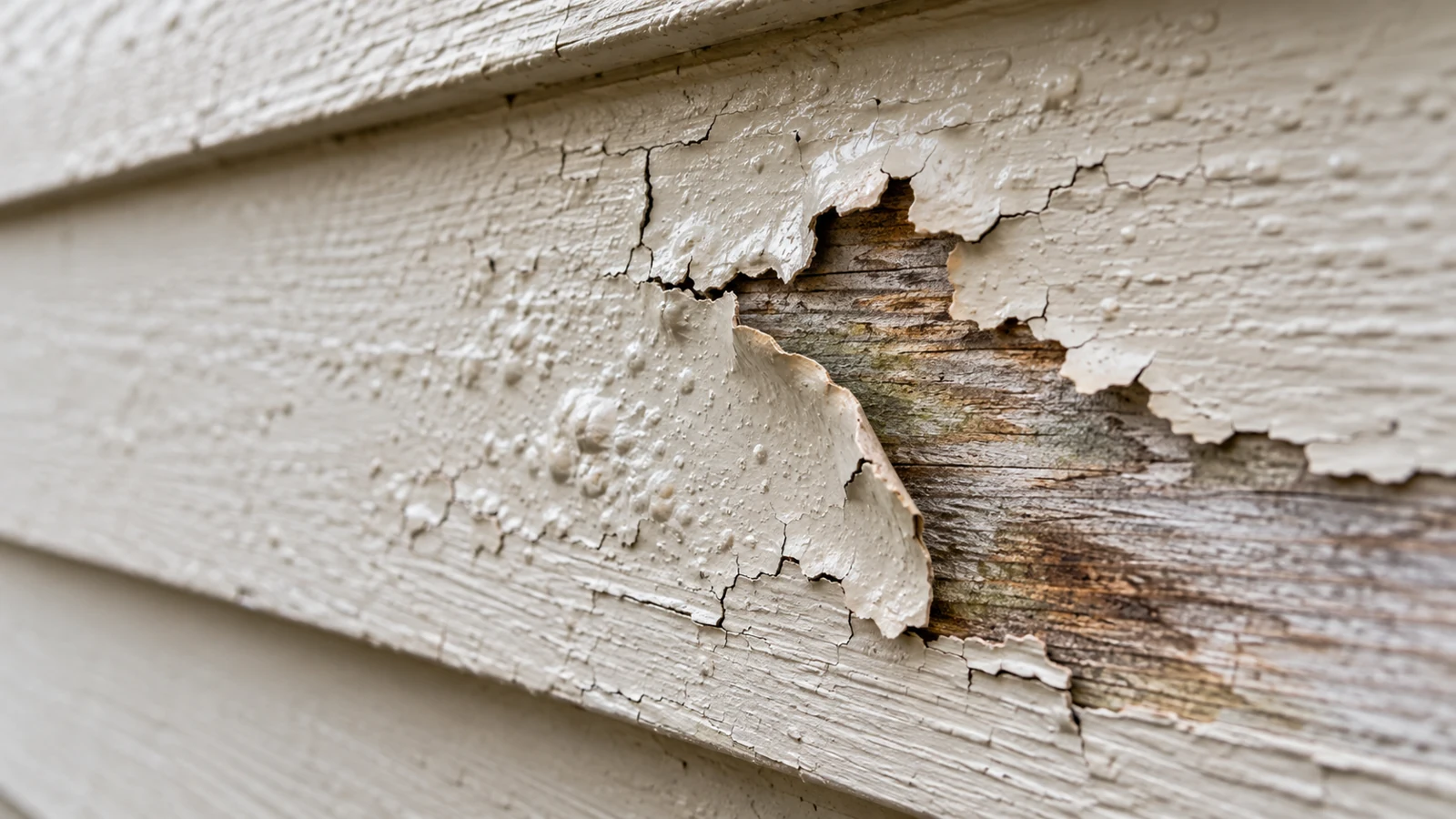
Start with a location and a timeline. Ask when the customer first noticed the issue, whether it changed after rain or another event, what prior work was done and whether a leak or other condition has been investigated. Walk the affected areas where safely accessible and record what is visible: lifted edges, bubbles, chalking, stains, cracks, soft material or a different finish over a patch. Separate the customer's report from your observation and from a hypothesis that still needs review.
Avoid diagnosing a whole building from one close-up photo. Similar-looking symptoms can have different causes and layers of failure. Record whether the concern is local or repeated across surfaces with different exposure, substrate or coating history. A useful first conclusion may be 'we need more information before fixing the scope.' That is more honest than promising that a higher-priced finish or a stain-blocking primer will correct every failure. The customer needs a decision path, not a confident guess.
Treat water and substrate concerns as separate decisions
If moisture is present or a stain keeps returning, determine who will investigate and address the source before the affected coating work proceeds. Manufacturer preparation guidance calls for locating and correcting a moisture source before painting. A painter may identify a concern without being qualified to diagnose or repair the roof, plumbing, flashing or assembly involved. Define that boundary clearly in the customer conversation and written scope.
Record the condition and the readiness requirement rather than assuming a previously repaired leak means every material is ready. Use an appropriate qualified assessment and the relevant product and substrate requirements. Do not prescribe a universal moisture number or drying period for all materials. If there is soft, deteriorated or otherwise questionable substrate, a cosmetic coating quote should not imply that it includes structural or concealed-material repair. Name the dependency and the person responsible for confirming the next step.
Plan further evaluation before disturbing old coatings
Review building age, available coating history and the proposed disturbance. Determine applicable EPA or authorized-state RRP obligations for covered work before scraping, sanding or testing in a way that disturbs painted surfaces. An ordinary repaint visit is not a reason to improvise a destructive test. Use the qualified process and required practices for the actual property and work. Do not tell the customer to collect a sample or remove a blister themselves for your convenience.
For other investigation, identify the question a test or sample would answer, who can perform it and what permission or protection is needed. Check current manufacturer guidance for the substrate and proposed system rather than applying a remembered test to every condition. Record access limits and unexamined areas. If a specialist or manufacturer representative needs to review the condition, capture the information they require without treating their general troubleshooting page as a diagnosis of this particular job.
Check the interface that is failing
Where appropriately assessed, distinguish coating coming away from the substrate from one layer separating from another. Record the accessible substrate, existing finish and known prior products, along with contamination, gloss, chalking or earlier preparation issues that may be relevant. Sherwin-Williams' peeling guidance identifies moisture and preparation conditions among possible contributors and directs users to the label and data-page requirements. Those are possibilities to investigate, not proof of cause on every peeling surface.
Keep the proposed repair tied to verified findings. Removing loose coating does not establish that all remaining material is sound, and a compatible finish does not restore a deteriorated substrate. If the condition varies by room or elevation, split the scope rather than averaging a small clean area with a difficult one. Describe any sample area or additional review needed before scaling the method. Record what result would allow work to continue and what result requires reassessment.
Write a bounded repair scope and an escalation gate
Specify the affected areas and the preparation, repair and coating work supported by the assessment. Identify included cleaning, removal, edge treatment, patching, compatible priming and finish work as appropriate to the selected system. State the repair boundary, protection and cleanup requirements, exclusions and what remains uncertain. Do not use 'repair all peeling' when neither party knows which layers or surfaces that promise covers.
Explain the change path if authorized preparation exposes more failure, damaged material or an unresolved source. Pause the affected area, protect it, document the finding, obtain the appropriate review and agree on the revised scope before continuing. Price a known repaint separately from uncertain investigation or other-trade repair. Avoid a permanent-performance promise that ignores the remaining assembly. The customer should understand both the work being purchased and the condition that must be resolved before that work makes sense.
Paint lifting below a window: investigate the recurring stain
Fictional planning example: paint lifts below one window, and the homeowner says the stain returns after heavy rain. The painter records the location and visible condition and asks about earlier repairs. The initial quote does not assume that scraping, a primer and a finish coat will stop the water. The next step is a suitable investigation of the source and affected material, with applicable older-coating review before disturbance.
After the appropriate repair and readiness confirmation, the painter can define the coating scope from the actual findings and current instructions. If adjacent coating is sound, that may support a limited repair; if more failure appears, the affected scope needs review. The proposal explains this decision boundary rather than hiding an unlimited allowance in the repaint price. This is a workflow illustration, not a diagnosis of window leaks or a specified repair method for an actual property.
Match expectations to the actual repair area
Discuss appearance as well as adhesion and substrate readiness. An aged finish, changed color, different sheen, texture or application method can make a spot repair visible. A small area of damaged coating does not always mean the visually acceptable finish can be limited to the same small spot. Assess the need to work to an appropriate break and obtain approval for that scope. Do not guarantee an invisible touch-up from a color code alone.
Agree on how the result will be reviewed and what product-specific care information the customer needs. Record the materials actually applied, the preparation completed and the areas intentionally excluded or deferred. If a sample or test area formed part of the decision, keep its approved result with the record. Clear expectations reduce the risk that the customer interprets a bounded coating repair as a warranty on every concealed source or layer around it.
Use callbacks to improve the next assessment
If the issue returns, compare the location, timing and symptom with the original evidence. Review the repair dependency, surface condition, preparation, selected system and application record before assigning a cause. A returning stain and an isolated missed edge do not belong in the same callback category. Give the customer a clear owner and next update, and arrange qualified review where the issue exceeds your scope.
Track the lessons by comparable condition and project type. Repeated surprises behind trim may indicate that the walkthrough needs a clearer access limitation. A patch appearance complaint may call for better sample review or a broader finishing option. Record actual investigation, preparation and callback hours separately from ordinary coating production. Improve the scope and training from evidence instead of applying an across-the-board primer upgrade that does not address the underlying problem.
Resolve the condition behind a recurring failure
Surface-preparation guidance calls for a sound, suitable substrate before coating. Record recurring moisture, failed material and the layer where adhesion was lost, then arrange the appropriate evaluation or repair. Define what must be resolved before painting rather than treating another coat as evidence that the cause is fixed.
Practical checklist
- Map location, timeline, extent and prior repairs.
- Separate customer reports, observations and unverified causes.
- Assign moisture-source or substrate investigation to an appropriate qualified person.
- Determine applicable older-coating requirements before disturbance.
- Define what further evaluation must establish.
- Write the repair boundary, preparation, system, exclusions and readiness gate.
- Pause and authorize changes when preparation reveals a different condition.
- Discuss appearance and touch-up limits before committing the finish area.
- Record actual products, preparation and unresolved conditions.
- Investigate recurring issues and feed evidence into the next estimate.
References and limits
These sources support the trade and business context; requirements vary by project and location. The job-specific observations, price, and safety plan belong with a qualified local professional.
Put this guide to work
Use the resource that fits your next step. These resources are FREE, with no account required.
Use your own job details and the appropriate professional review.