 BookedWork Pro
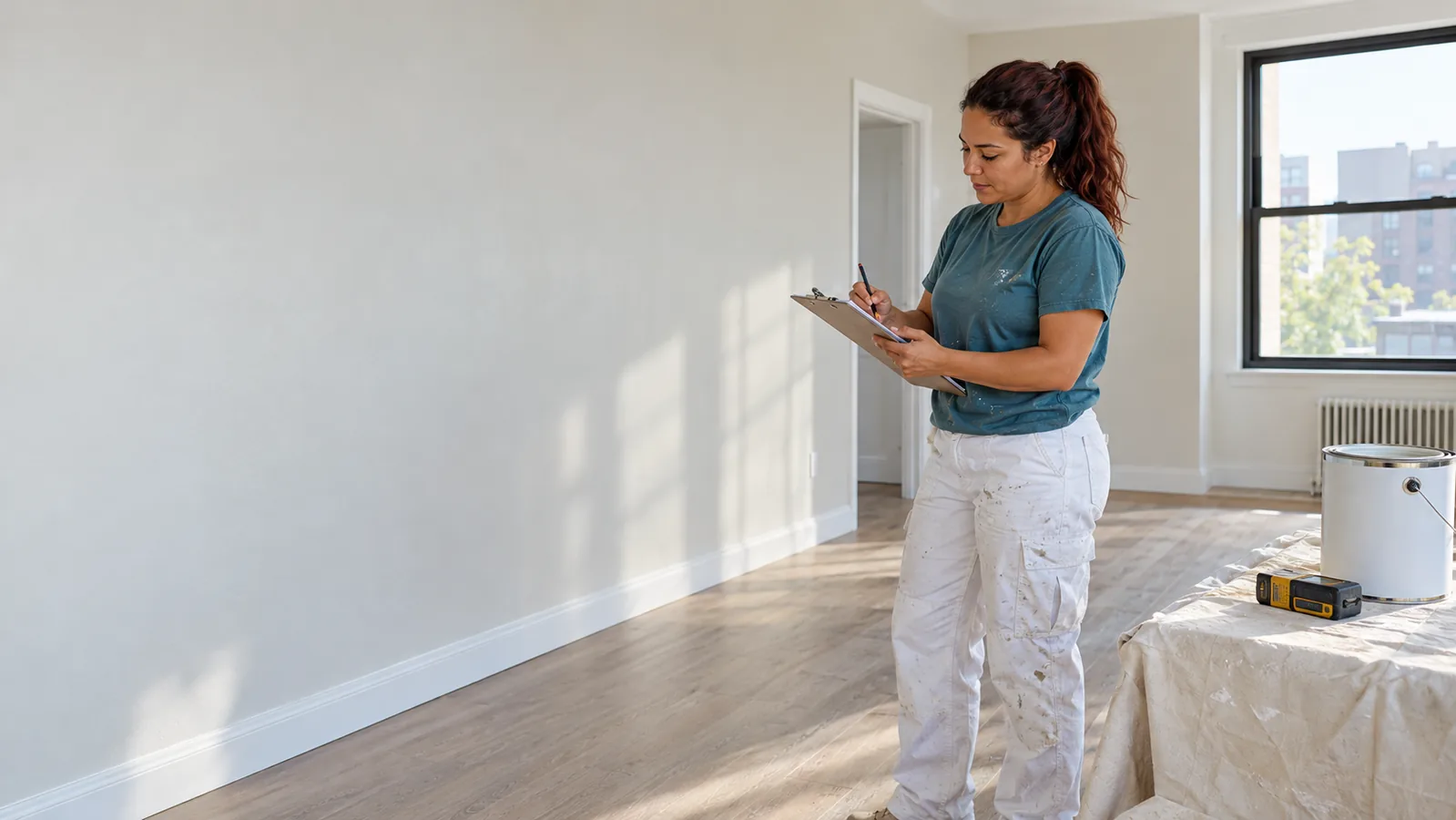
A working painter doesn't bid a repaint by guessing how many gallons will fit in the truck. A solid bid starts with the scope, a surface takeoff, honest production assumptions, prep and protection, and enough margin to cover the business after the crew gets paid.
Start with a walkaround, not a square-foot shortcut
Write down each room or elevation and separate walls, ceilings, trim, doors, cabinets, and specialty surfaces. Note the substrate, existing sheen, adhesion, stains, patching, caulk, access, and whether the house is occupied. A twelve-foot foyer is not the same job as an empty eight-foot bedroom. Ask about furniture, pets, parking, work hours, and who moves what.
Measure paintable wall area as wall length multiplied by wall height, subtracting large openings when useful for the takeoff. Keep trim and doors as separate line items because cut-in time, brushwork, masking, and enamel dry times can outweigh their square footage. On an exterior, split siding, fascia, soffits, doors, shutters, and exposed trim.
Build the labor estimate by task
Break the job into protection and setup, washing or cleaning, scraping or sanding, repairs and caulk, spot or full priming, cutting in, rolling or spraying, back-rolling where specified, second coat, cleanup, and punch-list time. Assign a production rate to each task using your own completed-job records. Don't borrow another contractor's “square feet per hour” without checking whether it includes setup, two coats, and prep.
For a hypothetical interior repaint, assume 1,200 square feet of measured wall surface and these illustrative painter-hour allowances:
| Task | Painter-hours |
|---|---|
| Protect floors, mask, move approved items | 5 |
| Patch, sand, caulk and spot-prime | 8 |
| Cut in and roll first coat | 12 |
| Cut in and roll second coat | 10 |
| Cleanup, walkthrough and touch-ups | 5 |
| Total | 40 |
Painter-hours are not elapsed hours: two painters working productively for eight hours provide sixteen painter-hours before breaks, travel, or interruptions. In this example, forty painter-hours equals roughly two and a half eight-hour days for two painters, before schedule buffers. Your actual pace will vary with texture, number of colors, height, trim detail, drying, and how much patching the homeowner expects.
Calculate coating quantities from the actual product
Read the selected primer and finish-coat technical data sheet for coverage, recoat interval, temperature, and substrate conditions. Estimate gallons as measured coat-area divided by the product's published coverage, then add a sensible allowance for texture, waste, and touch-ups. For example, at an assumed 350 square feet per gallon per coat, 1,200 square feet with two coats uses about 6.86 gallons before waste; round purchasing quantities according to packaging and real site conditions. Don't treat this example as a universal coverage rate. Deep color changes, porous drywall, rough masonry, and spray losses can change the takeoff.
List sundries separately: roller covers, brushes, tape, masking film, paper, drop cloth wear, abrasives, patch compound, caulk, primer, filters, spray tips, and disposal. The cheapest paint line may require more labor or coats; price the system you intend to apply.
Turn job cost into a selling price
Assume, strictly for illustration, 40 painter-hours at a fully burdened labor cost of $30 per hour ($1,200), $450 in paint and sundries, and $150 for equipment, transport, and disposal. Direct job cost is $1,800. If the company needs a 40% gross margin on the sale before fixed overhead, the mathematical selling price is $1,800 / (1 - 0.40) = $3,000. That's different from adding a 40% markup to cost, which would yield $2,520 and a lower margin. Decide how the company treats owner labor, payroll taxes, workers' compensation, office overhead, sales time, callbacks, and financing before adopting a pricing target.
No sample price is a recommendation for a real customer's home. Verify local labor cost, material quotes, job conditions, and your actual target margin.
Write the proposal so there is no “I thought that was included”
List every room or elevation; walls, ceilings, trim and doors; preparation; primer and finish products; sheen and approved colors; number of coats or performance-based coverage terms; protection; cleanup; work windows; and exclusions. Spell out whether closets, behind appliances, garage interiors, rotten wood, major drywall repairs, and lead-safe work are included. Put change orders in writing before extra work starts.
For pre-1978 housing, evaluate whether EPA Renovation, Repair and Painting requirements apply before disturbing coatings. Review EPA RRP contractor guidance and relevant state rules. Follow product instructions and appropriate OSHA safety requirements for access, ventilation, and equipment.
Learn from the last job
At closeout, compare estimated and actual painter-hours, prep hours, gallons, sundries, extra trips, change orders, and callbacks. If you bid eight hours of prep and used sixteen, record why: extra nail pops, wallpaper residue, poor adhesion, customer-added repairs, or missed inspection. Update your production assumptions for the next similar repaint instead of hiding the overrun inside the next customer's price.
A profitable painter knows which jobs the crew can finish cleanly, which scopes need a specialist, and which bid assumptions must be verified before promising a start date.
Worked example: find the overrun before changing your rates
Return to the fictional $3,000 job above. The bid allowed 40 painter-hours at $30, $450 materials and sundries, and $150 equipment, transport and disposal. Actual work used 46 painter-hours at the same burdened cost, $490 materials and $180 other direct costs. Actual direct cost is $2,050, leaving $950 gross profit and a 31.7% gross margin before fixed overhead, rather than the planned 40%. Revenue is assumed earned at the quoted price for this example; cash collected is a separate record.
| Cost | Estimate | Actual | Over estimate |
|---|---|---|---|
| Labor | $1,200 / 40 hours | $1,380 / 46 hours | $180 / 6 hours |
| Materials and sundries | $450 | $490 | $40 |
| Other direct cost | $150 | $180 | $30 |
| Total direct cost | $1,800 | $2,050 | $250 |
Suppose the six extra painter-hours were four hours of missed preparation and two hours of a customer-added surface. Keep those reasons separate. Revisit the preparation inspection and allowance for comparable future work; route the added surface through the written change process before doing it. Do not charge the customer for your estimating error by relabeling it as an approved change. If an added scope is approved, record its agreed revenue and costs separately so the base job remains comparable.
Save an estimate-to-actual working sheet
Download the FREE estimate-to-actual worksheet (.txt). Edit the plain-text file in a text editor or print a copy. It includes separate fields for task hours, material costs, approved changes and the reason for each variance. No account required.
Use the painter pricing calculator to explore your own assumptions, then use the proposal and scope-change guide to make the customer-facing agreement clear.
Field checklist
- Measure walls, ceilings, trim, doors, and specialty surfaces separately.
- Photograph existing substrate condition with permission.
- Price protection, prep, primer, each coat, and cleanup.
- Use the actual product's coverage and recoat instructions.
- Include burdened labor, sundries, travel, equipment, overhead and margin.
- Identify lead-safe, access, moisture and hidden-condition concerns.
- Get written color, sheen, scope, and change-order approval.
- Reconcile estimate against actual costs and callbacks.
Further reference: SBA break-even guidance and EPA RRP.